Poo An Bio Temple is one of three historic Chinese temples that form an important part of Lasem’s heritage district. It is located at Jalan Karangturi VII No. 13–15, Karangturi Village, Lasem District, Rembang Regency, Central Java.
The temple stands east of the Balai Kedamaian building, also known as Maha Karuna Monastery. Although it is situated beside a quiet village road, Poo An Bio retains an impressive character through its architecture, altars, and traditional paintings.
The History of Poo An Bio Temple
Poo An Bio Temple is believed to have been established around 1740. Its presence is closely connected to the development of the Chinese community in Lasem.
During an earlier period, many Chinese residents lived around the Lasem River and the main road running from west to east. As the population and trading activities expanded, their settlements developed southward toward the Kemendung River in Karangturi Village.
Poo An Bio Temple was constructed on the northern side of the Kemendung River. Its location illustrates the close relationship between places of worship, residential areas, trade routes, and the daily lives of Lasem’s Chinese community.
The Development of Karangturi’s Chinese Quarter
The establishment of Poo An Bio cannot be separated from the growth of Karangturi’s Chinese quarter. For Chinese communities living far from their ancestral homeland, temples served as places of worship as well as social gathering spaces.
A temple provided a place to preserve traditions, honor ancestors, and pray for protection in a new land. Poo An Bio therefore became one of the landmarks representing the development of the Chinese community in southern Lasem.
Karangturi remains known for its old houses, hand-drawn batik traditions, distinctive cuisine, and Chinese cultural heritage. Poo An Bio Temple continues to form an important part of the area’s identity.
Honoring Kong Tik Cun Ong
The main figure honored at the principal altar of Poo An Bio Temple is Kong Tik Cun Ong, also known as Guangze Zunwang. He is traditionally regarded as a protector of travelers and people living far from their homeland.
According to Chinese tradition, ancestors traveling overseas often carried a statue or sacred representation of Kong Tik Cun Ong. It was preserved and honored as part of their religious practices.
A similar tradition is believed to have been followed by Chinese migrants who became the ancestors of Lasem’s Chinese community. They prayed to Kong Tik Cun Ong for protection and safety while establishing their lives away from their ancestral homeland.
This tradition was passed down to later generations. Kong Tik Cun Ong consequently occupies the main altar and remains an important part of the spiritual life of Poo An Bio Temple.
Facing the Kemendung River
Poo An Bio faces south toward the Kemendung River. This orientation reflects the river’s importance as a transportation route in the past.
Before the construction of the Great Post Road, also known as the Groote Postweg or Daendels Road, the Kemendung River was one of Lasem’s main transportation arteries. It connected with the Lasem River, which provided access to the former port.
Residents and merchants used the waterways to transport goods and travel between different parts of the region. These activities made the area around the Kemendung River an important part of Lasem’s economic and social life.
The temple’s orientation toward the river demonstrates that the historical development of Lasem was not originally centered on roads alone. Its waterways played a major role in shaping settlements, trade, and the expansion of Karangturi’s Chinese quarter.
A Symmetrical Temple Gateway
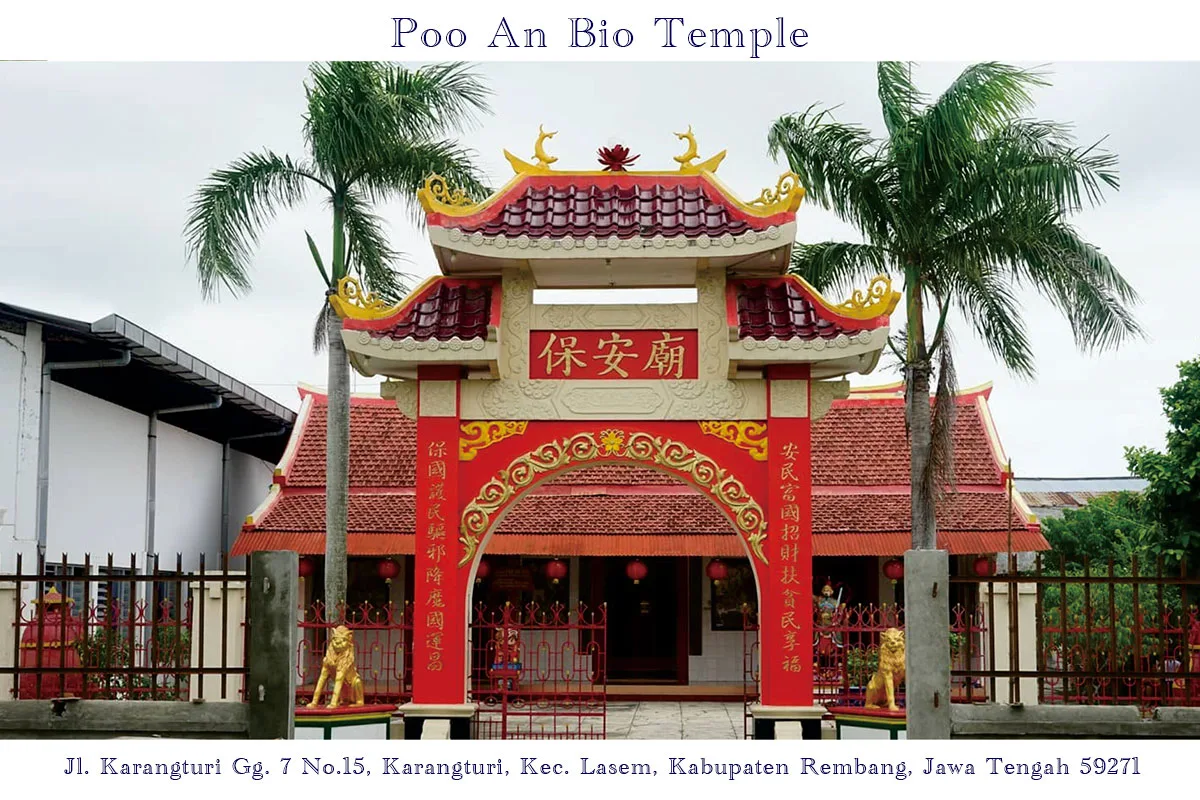
One of the most interesting architectural features of Poo An Bio is its main gateway, known as a shan men. Its design consists of three symmetrical rectangular sections.
The central section is higher than the two matching sections on either side. This composition creates a visual balance commonly associated with the principles of Yin and Yang in Chinese culture.
Traditional temple gateways are often decorated with two dragons facing each other. Between them is usually a huo zhu, or flaming pearl, symbolizing wisdom, spiritual power, and perfection.
However, the animal figures on the gateway of Poo An Bio do not appear as clearly shaped as conventional dragon ornaments. This detail gives the gateway a distinctive character compared with those found at many other Chinese temples.
Guardian lion statues stand on the left and right sides of the entrance. In Chinese architectural tradition, these paired lions symbolize protection and guard the entrance to an important or sacred place.
The Incense Burner and Joss Paper Furnace
After passing through the shan men, visitors can look to the right to find a kim lo, a furnace used for burning ceremonial paper. The kim lo at Poo An Bio resembles a bottle and is dominated by the color red.
Continuing toward the main building, visitors encounter guardian figures before reaching the entrance. A brass hiolo, or incense burner, stands directly in front of the main doorway.
Worshippers use the hiolo to place burning incense during prayer. Together, the kim lo, guardian statues, and incense burner form an important part of the temple’s spatial arrangement and religious rituals.
Traditional Paintings Created with Mo Pit
One of the special features of Poo An Bio Temple is the collection of paintings decorating its interior walls. These artworks were created using mo pit, a traditional Chinese brush, and black ink.
Detailed brushwork gives the figures and scenes a vivid appearance. Beyond their artistic value, the paintings communicate stories and moral teachings taken from classic Chinese literature and folklore.
Their presence makes Poo An Bio more than a place of worship. The temple also provides an opportunity to study traditional art, literature, and the cultural values of Lasem’s Chinese community.
The Story of Sam Kok
Several paintings inside Poo An Bio illustrate the story of the Three Kingdoms, commonly known in Indonesia as Sam Kok or internationally as Romance of the Three Kingdoms.
The story follows political conflict, warfare, friendship, loyalty, and struggles for power near the end of the Han Dynasty. Its best-known figures include Liu Bei, Guan Yu—also known as Kwan Kong—and Zhang Fei.
The three figures are remembered for their oath of brotherhood and their struggles through periods of war. Their story conveys lessons about courage, loyalty, strategy, responsibility, and devotion.
Other paintings at Poo An Bio also present historical figures and folk stories containing moral teachings. One of these concerns Yue Fei, a renowned general of the Song Dynasty celebrated for his courage and loyalty to his country.
A Historical Landmark beside the Kemendung River
Poo An Bio is more than a religious building. It is a witness to the development of Karangturi’s Chinese quarter, the changing transportation network, and the lives of Lasem’s Chinese community over several centuries.
Its orientation toward the Kemendung River recalls a time when waterways formed the center of daily activity before the Great Post Road changed the direction of Lasem’s urban development. The worship of Kong Tik Cun Ong, meanwhile, reflects the hopes of overseas migrants seeking protection in a new land.
Its symmetrical gateway, guardian statues, altars, incense burner, and traditional wall paintings make Poo An Bio an important destination for discovering Lasem’s history and cultural heritage.
As the temple remains an active place of worship, visitors should maintain a respectful atmosphere, wear appropriate clothing, observe local rules, and avoid disturbing religious activities.
If you would like to learn more about Poo An Bio and explore Karangturi’s historic Chinese quarter, you can join a heritage journey with Rumah Merah Heritage Lasem. After visiting the temple, traditional houses, batik workshops, and local culinary destinations, you can also stay at Rumah Merah Heritage Lasem and experience the atmosphere of a historic building in this culturally rich town.