Lasem is home to one of the most historically significant Chinese quarters on the northern coast of Java. Its cultural landscape is centered around three Chinese temples: Tjoe An Kiong Temple in the Dasun area, Poo An Bio Temple in Karangturi, and Gie Yong Bio Temple in Babagan.
Among them, Tjoe An Kiong is widely known as the oldest Chinese temple in Lasem. This temple, which displays the characteristics of classical Fujian architecture, is also called Ci An Gong, meaning the “Palace of Virtue and Peace.”
The History of Tjoe An Kiong Temple
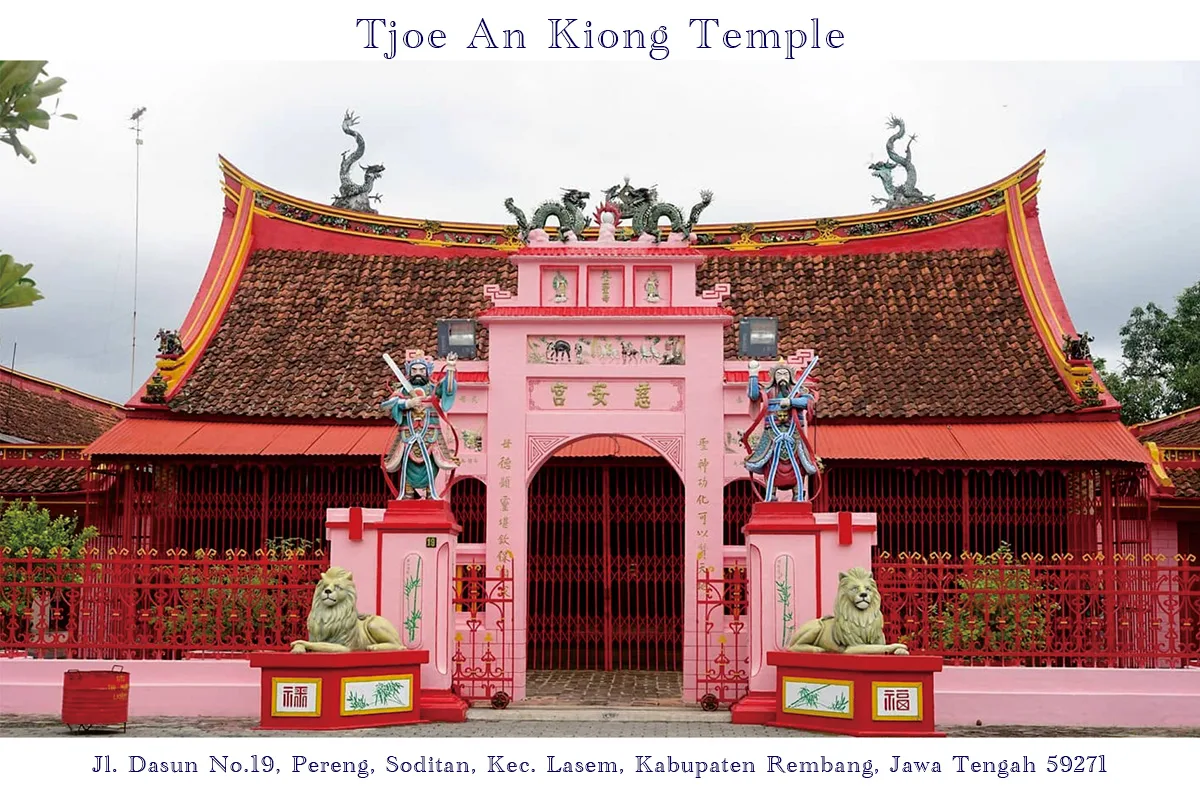
Tjoe An Kiong Temple is located at Jalan Dasun No. 19, Soditan Village, Lasem District, Rembang Regency, Central Java. The temple is believed to have been established around the 15th century, although no definitive record of its original construction date has been discovered.
Several inscriptions indicate that Tjoe An Kiong Temple underwent restoration in 1838. Another major renovation was carried out in 1869. Its long history has made the temple an important architectural landmark documenting the development of the Chinese-Indonesian community in Lasem.
Ma Zu as the Temple’s Main Deity
The principal deity worshipped at Tjoe An Kiong Temple is Ma Zu, also known as Thian Siang Sing Bo, Mak Co, Tian Hou, and Ma Zu Po. She is the Goddess of the Sea and has long been revered by Chinese fishermen, sailors, and overseas travelers.
Her worshippers believe that Ma Zu protects those who cross the sea, granting them safety and favorable weather during their journeys.
Before the beginning of the fishing season, fishermen and sailors traditionally hold ceremonies in her honor. An important celebration is also observed on the 23rd day of the third month of the Chinese lunar calendar, which is believed to be Ma Zu’s birthday.
During the ceremony, worshippers light candles and sandalwood incense, present various food offerings, and pray for protection. Ma Zu holds a particularly important position among Chinese-Indonesian communities, including those living in Lasem. Her sacred figure occupies the main altar of Tjoe An Kiong Temple.
Visitors are expected to respect the temple’s rules and its role as an active place of worship. This includes observing restrictions on photographing the sacred figure of Ma Zu.
Classical Fujian Architecture
The design of Tjoe An Kiong Temple reflects the architectural traditions of southern China, particularly those of Fujian. Its buildings are arranged in a rectangular courtyard layout known as a siheyuan.
One of the temple’s most distinctive architectural features is its swallowtail roof. This ying shan roof form, also known as yinwei xing, has upward-curving ends that resemble the tail of a swallow.
Swallowtail roofs became popular during the Qing Dynasty, which lasted from 1644 to 1911. In traditional Chinese architecture, this roof form was generally reserved for temples and government buildings.
Lasem, however, developed its own adaptation of the style. Several historical houses in Lasem’s Chinese quarter also feature swallowtail roofs. Their roofs and façades are decorated with symbolic ornaments associated with good fortune and protection against misfortune.
Symbols of Yin and Yang
The main building of Tjoe An Kiong Temple contains numerous symbolic ornaments. Each shape, color, and decorative element serves not only as an artistic feature but also as an expression of philosophical values.
The decorations represent the balance between Yin and Yang and embody hopes for a life filled with virtue, safety, harmony, and prosperity.
Visitors can also find murals depicting Chinese deities and an extensive series of monochrome paintings covering the temple’s interior walls. These murals are among the features that distinguish Tjoe An Kiong from many other historic Chinese temples in Indonesia.
The 100-Panel Fengshen Yanyi Murals
The interior walls of Tjoe An Kiong Temple are decorated with highly detailed black-and-white murals. Unlike several major Chinese temples in Indonesia that display scenes from the Romance of the Three Kingdoms, the murals at Tjoe An Kiong illustrate 100 panels inspired by Fengshen Yanyi.
Also known as Fengshenbang or The Investiture of the Gods, Fengshen Yanyi is a classic Chinese literary work commonly associated with Xu Zhonglin. Developed during the Ming Dynasty, it combines elements of mythology, history, folklore, legend, and fantasy.
The story is set during the final period of the Shang Dynasty and the rise of the Zhou Dynasty. It follows the fall of the last Shang ruler and the struggle of King Wu of Zhou. Its narrative features warriors, strategists, deities, spirits, and a wide variety of mythological beings.
Each scene is illustrated through detailed ink work on the temple walls. The composition of the characters, movements, and settings makes the narrative appear remarkably vivid. These 100 panels make Tjoe An Kiong an important place for studying Chinese mural art and mythology in Lasem.
Couplets and Moral Teachings
Tjoe An Kiong Temple also preserves numerous traditional couplets and inscribed wooden plaques containing proverbs and moral teachings. Some of them date from the reign of the Guangxu Emperor of the Qing Dynasty, between 1875 and 1908.
The inscriptions express hopes for safety, virtue, harmony, and a beautiful life. In addition to their artistic value, these couplets and plaques form an important part of the temple’s historical record.
The beauty of Tjoe An Kiong Temple extends beyond its architectural design. Its murals, ornaments, altars, couplets, and sacred symbols contain philosophical values and moral teachings passed down through generations. Local stories of mystical and spiritual experiences further enrich the temple’s cultural appeal.
Visiting Lasem’s Oldest Chinese Temple
Tjoe An Kiong is more than a place of worship. It is an important part of Lasem’s history and cultural identity. Its classical Fujian architecture, devotion to the sea goddess Ma Zu, 100-panel Fengshen Yanyi mural, and symbolic decorations make it a remarkable destination to visit and study.
Visitors should maintain a respectful atmosphere, wear appropriate clothing, follow the temple’s rules, and avoid disturbing worshippers during religious activities.
If you would like to visit Tjoe An Kiong and discover Lasem’s other historical destinations, you can join a heritage journey with Rumah Merah Heritage Lasem. After exploring the Chinese quarter and learning about Lasem’s cultural heritage, you can also stay at Rumah Merah Heritage Lasem and experience the atmosphere of a historic building connected to the town’s long and fascinating story.